By R. Lee Ingalls
Part 1 of 2: Just Because You Can, Does It Mean You Should?
I really need to stop saying I don’t write articles like this, because apparently I do.There is simply too much happening around us not to occasionally speak up.So here I am again, this time with a reminder for corporate America:
Doing the right thing is not bad for business.
In fact, there was a time when being a good corporate citizen was something companies seemed proud of. Businesses wanted to be part of the communities they served. They wanted loyal customers, certainly, but they also seemed to understand that loyalty was a two-way street.
Somewhere along the way, I wonder if we have lost that.
My original thought was to make this a single article. Once I started writing, however, I realized each of these issues deserved more than a paragraph or two. So this became a series, two parts for now, although I reserve the right to add more.
Let’s begin with something most homeowners probably never think about until it affects them personally.
Utility Easements and Rights-of-Way
If you live in Houston, you may already know where I am going with this one.There is generally an easement or public right-of-way along residential property where utility and telecommunications companies may have the legal authority to install, maintain or upgrade their infrastructure.
Fair enough.
We all want electricity, internet, telephone service and the other conveniences of modern life. Infrastructure has to go somewhere.
But here is where I believe we need to make an important distinction:
Having the legal authority to do something does not necessarily make it good corporate citizenship.
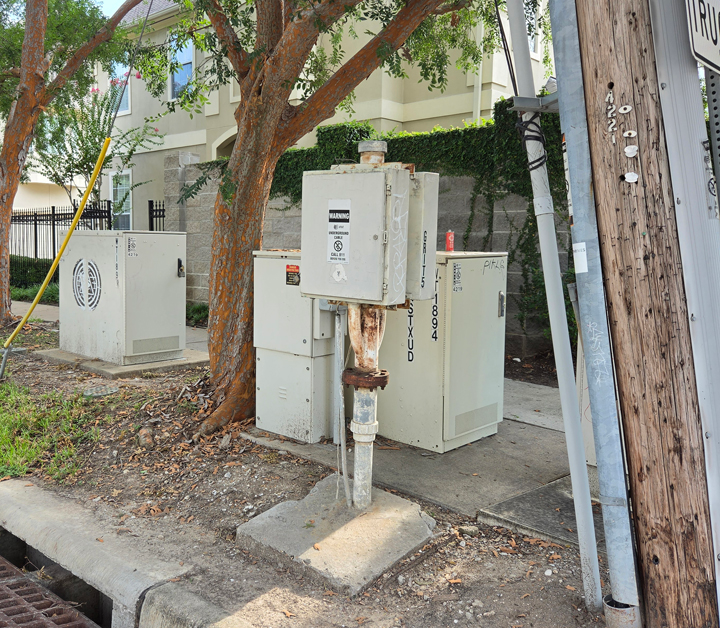
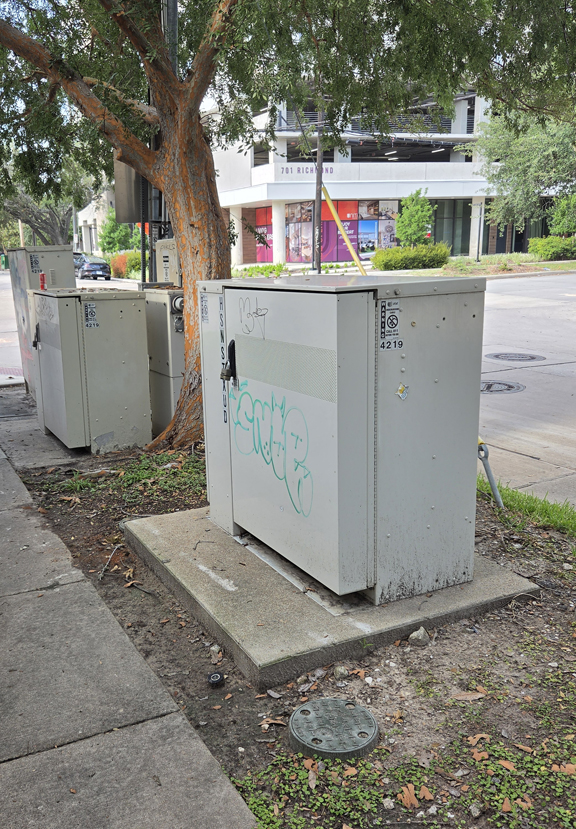
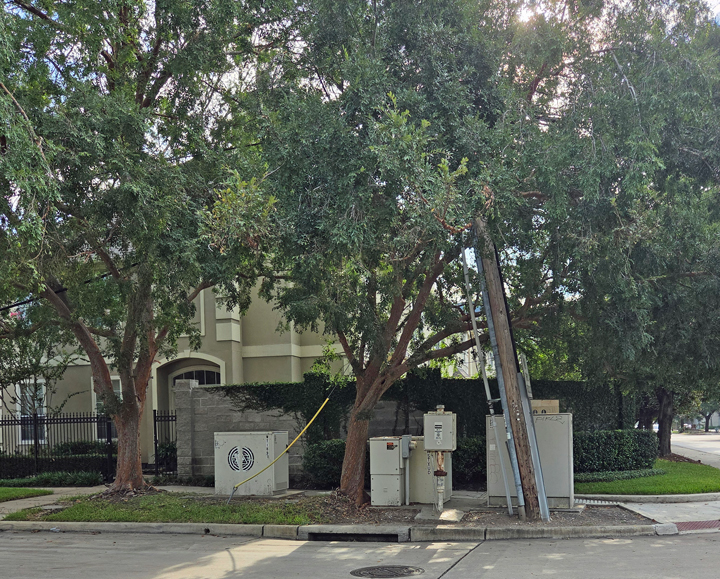
Imagine a company needs to “improve” its infrastructure in front of your home. Workers arrive, dig up the area, remove landscaping and install large utility boxes.
Not one box.
Not two.
Perhaps three or four.
Depending on the circumstances, all of this may happen with little meaningful communication with the homeowner.
Here is the irony: As the homeowner, you are expected to maintain the property. You mow it. You landscape it. You water it. You spend money making it attractive because it contributes to the appearance and value of your home.
Yet you may have remarkably little control over what someone else places there.
When the work is finished, landscaping you paid for may be gone. In its place are utility boxes surrounded by patches of newly installed grass that may already be struggling to survive.
Is that really the best we can do?
What Happens When the Equipment Is No Longer Needed?
I have even been told that one of the boxes in front of our house is no longer being used.
Naturally, my next question was: Then why is it still there?
The answer, as I understood it, essentially came down to cost. Removing unused infrastructure costs money. Leaving it where it is costs less.
That may make perfect sense on a spreadsheet.
But does it make sense as a corporate neighbor?
That question gets to the heart of this article.
Corporations make financial decisions every day. I understand that. They have shareholders, budgets, employees and operating expenses.
But what happens when a company’s cost savings become someone else’s burden?
The company saves the expense of removing an obsolete box. The homeowner gets to look at it every day.
The company installs the infrastructure it needs. The homeowner deals with the landscaping.
The company moves on to its next project. The equipment remains in front of someone’s home for years, perhaps decades.
Who is really paying the price?
Then There Is the Appearance of the Neighborhood
These boxes aren’t exactly architectural features.
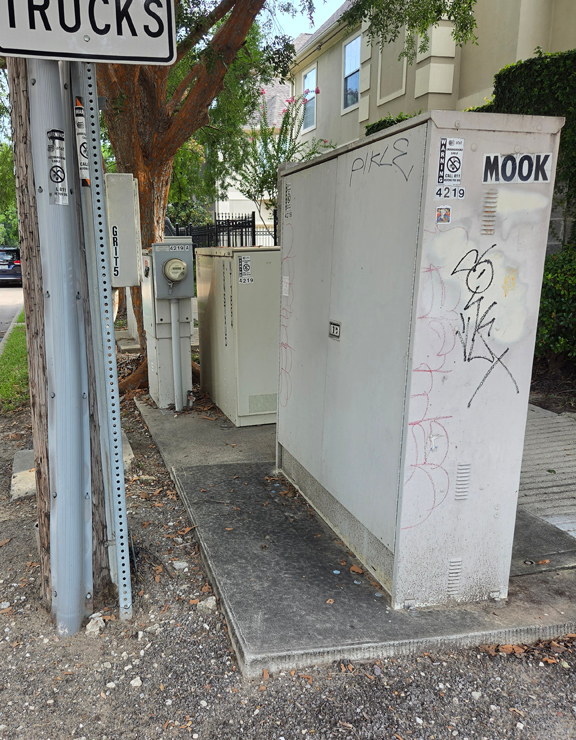
Several large utility cabinets clustered in front of a home can affect its curb appeal and potentially influence how prospective buyers perceive the property. For a homeowner who has invested considerable time and money maintaining a home, that matters.
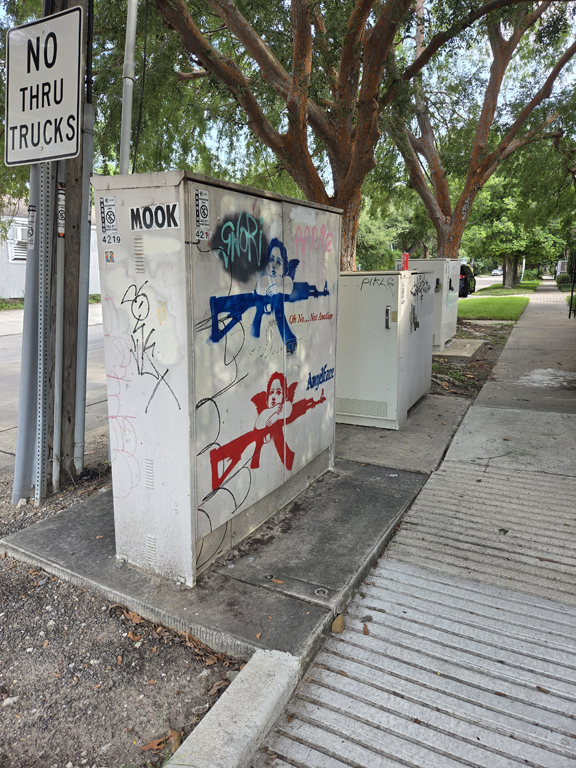
Then there is another problem: graffiti.
Apparently, large metal utility boxes can look like blank canvases to people carrying spray paint.
The boxes in front of our home have been tagged numerous times. I have included photographs showing what they look like right now.
That raises another question.
Houston has ordinances addressing graffiti on private property and mechanisms for requiring property owners to remove it. If homeowners and businesses are expected to address graffiti on their property, shouldn’t corporations also take responsibility for keeping their equipment maintained?
Why should a utility cabinet be allowed to remain covered in graffiti simply because the owner of that cabinet is a large corporation rather than the person who owns the home behind it?
To me, that is part of being a good corporate citizen.
If it is your equipment, maintain it.
If it is no longer needed, remove it.
If your work damages someone’s landscaping, restore it properly.
And if you are going to significantly alter the appearance of the property in front of someone’s home, communicate with them.
None of that seems unreasonable.
And It Doesn’t Stop at the Curb
The same attitude can appear in much smaller ways.
When one company required me to switch to fiber-based service, a technician came to our home to complete the installation. Before he started, I explained where and how I wanted the new wire installed.
He agreed.
Later, I went outside to check the work and discovered he was preparing to run the new wire directly across the back of our house, in plain view.
I stopped him and reminded him of what we had discussed.
To his credit, he changed it and installed the wire as requested.
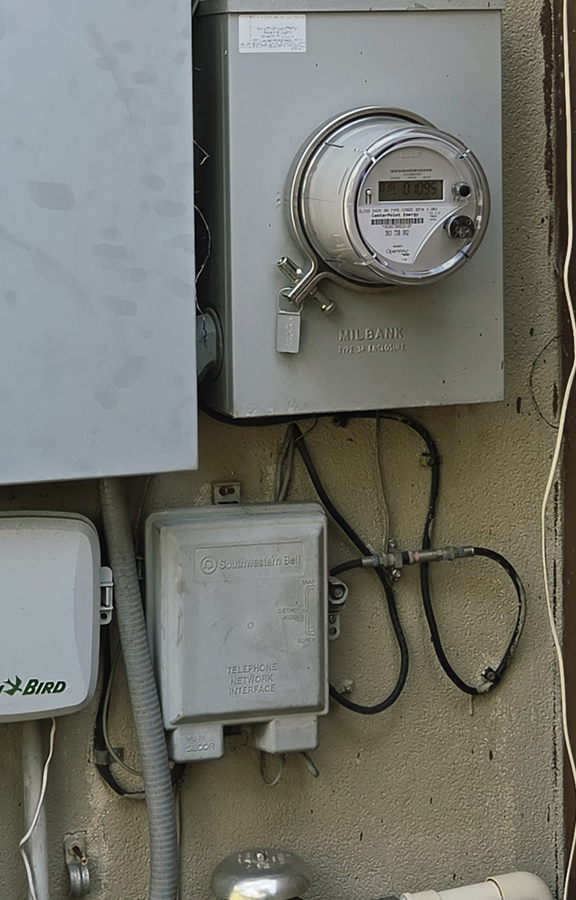
Then I asked about the old box and wiring still mounted on the house.
Were they going to remove those?
No.
They were simply going to leave them there.
Think about that for a moment.
The company needed its new infrastructure installed, and that was important enough to send someone to my home to do the work.
But removing the company’s obsolete infrastructure?
Apparently, that was my problem.
Legal Responsibility vs. Corporate Responsibility
And that brings me back to where I started.
This isn’t simply about utility boxes, dead grass, abandoned wiring or graffiti.
It is about a larger question:
What does it mean to be a good corporate citizen?
A company can comply with every applicable law and still leave its customers and the communities it serves feeling ignored.
Corporate responsibility should not begin and end with, “Are we legally allowed to do this?”
Perhaps the better question is:
“If we do this, what are we leaving behind for the people who live here?”
Companies depend on our neighborhoods. Their customers live here. Their employees live here. Their infrastructure runs through our yards, along our streets and across our communities.
That makes them more than service providers.
It makes them neighbors.
And good neighbors don’t simply ask what they are allowed to do.
They ask what they should do.
Maybe it is time for corporate America to start asking that question again.
Coming in Part 2: another look at what happens when corporate policies, customer service and common sense stop occupying the same room.