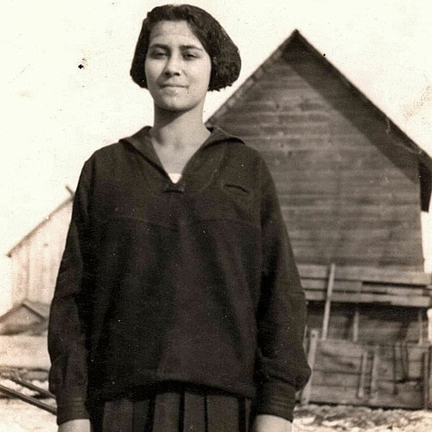
On December 20, 1907, Frank Conrad Supri and Leah (Baudette) Supri welcomed their second child into the world, a daughter they named Clara. The family lived on a farm outside the small river town of Pepin, Wisconsin, in a time when the landscape was still largely untamed and the modern conveniences we take for granted simply did not exist.
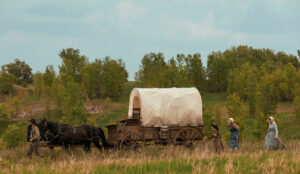
There were no real roads beyond the towns then. Travel was by horseback or horse and buggy, and isolation was a fact of daily life rather than a choice. Like most farmers of the era, the Supri family relied heavily on their team of working horses. They were essential partners in survival, plowing the fields during the growing months and, during the long northern winters, hauling Frank to a logging mill nearly thirty miles away. Before leaving each winter, Frank made certain the family was well supplied, knowing that once the snow fell, they would be confined to their home until the spring thaw. For the first seven or eight years of Clara’s life, this rhythm of labor, preparation, and isolation defined their existence.
Eventually, Frank and Leah decided that farm life was simply too difficult. They moved their family into town, where Frank found work at the livery stable. Yet this change brought unintended consequences. Proximity to the local saloon became part of Frank’s daily routine. In those days, there were no mixed drinks, only straight shots of whatever spirit one chose, and a few shots could easily turn into many. No one ever said it outright, but it was understood that Frank succumbed to what was then called “alcohol disease.” He died at just thirty-nine years old, leaving Clara fatherless at the age of nine.
His death sent the family into immediate crisis. Leah, suddenly a widow, could not afford to house and feed six children. With heartbreaking resolve, she made the decision to place her three sons in an orphanage. She kept her three daughters with her, and together they worked to survive, taking in laundry, washing and ironing for others, doing just enough to keep themselves together as a family.
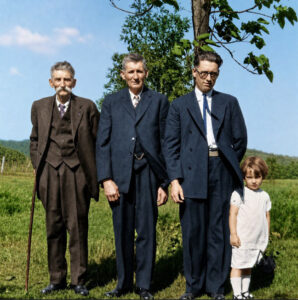
At sixteen, Clara married my grandfather, Wilford Patnode. Life did not grow easier. If anything, it grew heavier. Another force was quietly taking hold, Clara suffered from profound depression. My grandfather always referred to it as “the darkness.” He believed the entire Supri family carried it to some degree, but in Clara it grew deeper with each of her four pregnancies.
On October 10, 1930, Clara and Wilford welcomed their third child, Giles. It was one year after the stock market crash, at the very beginning of the Great Depression. Hardship became relentless. The following year, Wilford was injured by a cow while milking, an accident that left him in traction for extended periods and unable to tend the farm as needed.
Then came family turmoil. Clara’s two sisters attempted to replace the aging stove their mother used, discarding the old one before they had secured jobs or money to purchase a new one. The resulting argument escalated, law enforcement was called, and Leah was taken to a treatment hospital while the courts determined her fate. During this upheaval, Clara became pregnant once more.
On June 28, 1932, she gave birth to her fourth and final child, my mother, Fern. Shortly afterward, the court ruled that Leah would need to be institutionalized permanently. The only person able to take responsibility for her was Clara.
It was too much.
My grandfather later told me that Clara fell into one of her darkest spells, a period of the darkness that lasted longer than any before. For more than two weeks, she could not break through it.
Then, on October 10, 1932, Giles’s second birthday, Clara walked into the barn where Wilford was milking the cows. She sat with him and talked. He said she seemed better, restored, her usual happy and talkative self. He was filled with relief, believing his wife had returned to him. After a few minutes, she left the barn.
Two hours later, their oldest child, Warren, found her in the hayloft. Clara had taken her own life.
The family was never the same. Even thirty years later, the sorrow lingered so deeply that I could sense it in those who remained.
Among my grandfather’s writings is this reflection about Clara:
“At 25 I found I had outgrown my youth and my friends were all married. So I got on the bandwagon and on March 3, 1924 I was married to the finest girl in all the world and I have four children to prove it.”
Though I never knew my grandmother, I often wish I could have had just one conversation with her, or know with certainty which of my instincts, strengths, or sensitivities I inherited from her. Today, I remember her not for the way her life ended, but for the life she lived, the children she brought into the world, and the quiet strength she carried far longer than anyone should have had to.
Today I remember my grandmother, Clara Supri.
The details of this story were preserved through the memories and writings of my Grandpa Wilford, along with the recollections of my mother, Fern. Their voices help keep Clara’s story alive and allow us to better understand not only the life she lived, but the quiet strength it took to live it.
Depression and emotional hardship are not just things of the past; they still touch members of our family, as they do so many families everywhere. In sharing this story, I hope to honor not only my Grandmother Clara, but also all those who carry unseen burdens.
I dedicate this post to everyone who suffers in silence or struggles to find their way through the darkness. Please know this: you are seen, you are valued, and you are deeply loved.